
Electric reefer container guide
An electric reefer container gives you cold storage almost anywhere on your site, without any building work – as long as you’ve got the right power for the unit.
A stationary refrigerated container uses powered cooling equipment to hold the temperature you set. Once installed and connected correctly, it gives you temperature-controlled space at your own site.
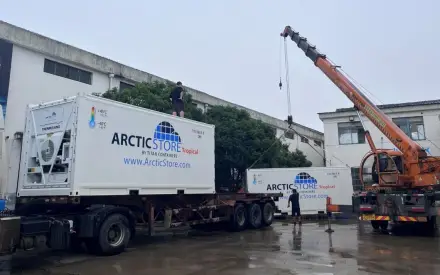
Available for purchase or rent, they provide cold storage wherever it’s needed – often in tight spaces where construction work would be difficult. They are especially well suited to temporary cold storage requirements.
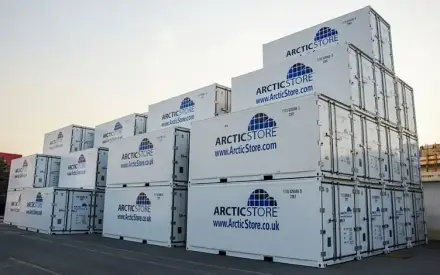
TITAN’s ArcticStore containers operate from -40°F to +113°F and come in 10ft, 20ft and 40ft sizes. Getting their power supply right is an important step. Consider the temperature you need and the model you’ll use before anyone plans the electrical work.
One important point: “Electric reefer unit” can mean equipment built for different jobs. This guide is about stationary onsite cold storage. If you’re asking about an electric standby reefer used in transport, say so first, and we’ll tell you whether we can help and match our advice to your needs.
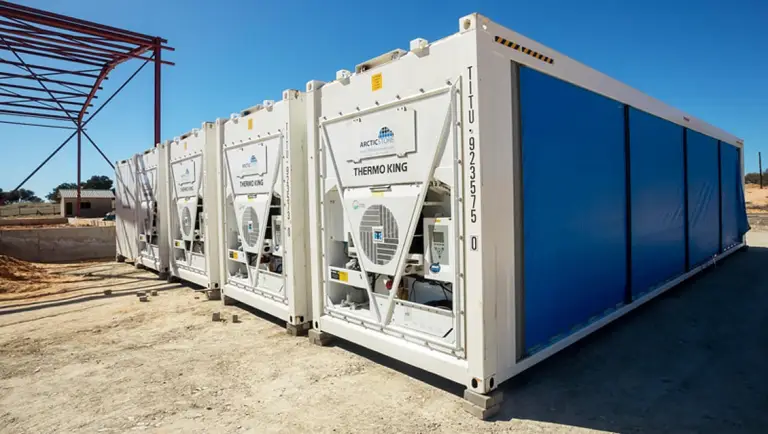
Our standard US ArcticStore units, in 10ft, 20ft and 40ft, are listed for a 480V, 32A, three-phase supply with a four-pin connection. Treat that as your starting point, and give your electrician the documentation supplied with the unit so they can confirm the final installation.
We also offer a more energy-efficient model, ArcticStore Horizon, with additional solar panels to reduce mains consumption.
No single connection specification suits every refrigerated container, so get the requirements for the exact unit you’re being supplied and pass them to your site’s qualified electrician. They’ll also need to know where the cable will run and what conditions it will face.
This table shows the information your electrician will need:
| What to ask for | Why the electrician needs it |
|---|---|
| Supply voltage and phase | To match the unit to the site’s electrical system |
| Frequency | To verify compatibility with the equipment |
| Rated demand and starting characteristics | To assess capacity and protection |
| Connector and isolation requirements | To plan a suitable, safe connection |
| Cable route and distance | To assess the installation for the actual site |
| Environmental exposure | To select suitable protection and routing |
Don’t pick a breaker, cable, adapter or generator from a generic example you’ve found online. Each setup has to suit your equipment and installation.
Contact us about your rental to discuss the best model and obtain the electrical information your site team needs.
A connector that fits doesn’t prove the supply is correct. And don’t assume a nearby outlet has enough capacity just because nothing else is using it right now.
Have the installation checked before the container arrives, and agree:
Keep the cable and connection away from vehicle routes, water and anything that could damage them. If there’s a fault, follow the supplier’s instructions for isolating and restarting the unit, and don’t improvise a procedure on the spot.
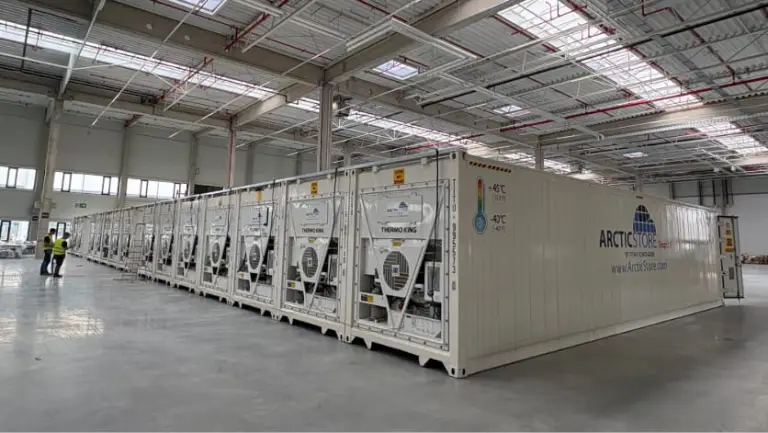
Your site’s electrical supply has to be big enough for the most power the unit can draw at once. Power is measured in kilowatts (kW), and checking the supply against it is your electrician’s job.
Running costs depend on something different: energy, which is how much electricity the unit uses over time, measured in kilowatt-hours (kWh). A nameplate or connection rating isn’t a daily kWh figure, so don’t treat it as one.
How much energy the unit uses depends on the setpoint, the weather, the insulation, how often the door opens and the temperature of the goods going in. Ask for an estimate based on a job similar to yours, then measure a representative period once the unit is running.
To estimate the cost, multiply the expected kWh by your electricity rate. Check any demand charges and other fees on your business tariff separately.
Coordinate the power work with the delivery plan. When choosing a position for the container, consider:
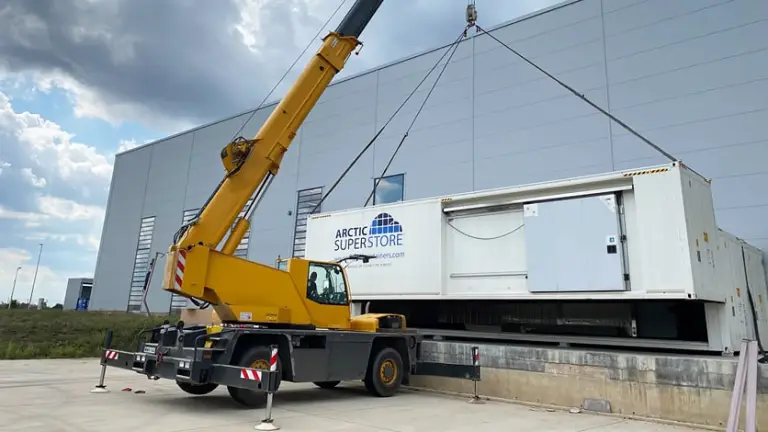
Read our container delivery guidance and feel free to share a site plan and photographs when booking your rental container. The last thing you want is a container arriving only to find the power supply is on the wrong side of a busy vehicle route.
Once the container is in place and connected, complete the commissioning and acceptance checks, and bring it to the required storage conditions before you load any goods. If your product needs qualification or independent monitoring, build that into your readiness plan.
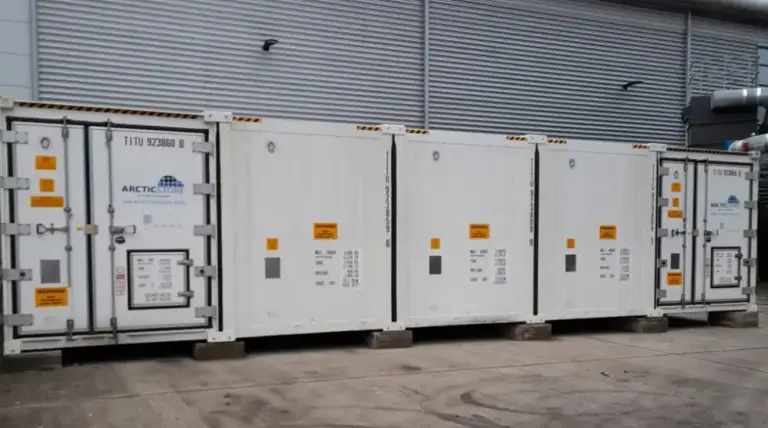
If a power outage could put your stock at risk, decide how you’ll respond before it happens: who gets the alarm, who checks the site and where the goods can go if you can’t get the cooling back.
If you’re choosing a backup generator, pick one that is sized to the unit’s actual electrical load, including the surge when it starts up. Fuel, where the generator sits, how it connects, testing and maintenance all need a qualified specialist.
Never connect a generator to a building’s wiring through an improvised route. Any transfer arrangement – the switch that moves your supply between mains and generator – has to be designed and installed for your site.
That’s why comparing a generator with site electricity isn’t just a question of fuel prices. Any reefer generator vs electric debate also has to cover how reliable and safe the whole supply arrangement is.
Train staff on the normal controls, alarms and agreed reporting route. Keep the unit ID and service contact available to every shift.
SmartArctic remote monitoring – available with most TITAN ArcticStore containers – helps you review performance and control settings remotely. Your stock protection plan should also cover what happens if communication or site power is lost.
If the supply trips, don’t keep resetting it. Investigate first, following the agreed procedure, and write down the time, the alarm, what’s been happening recently and which stock is affected. Leave technical work to the people authorized to do it.
Keep them with your facilities documents, so they’re readily available when someone needs them. If something goes wrong, nobody wants to hunt through old files, so note the unit ID, keep the electrical specification you were given and mark the agreed connection and isolation arrangements. Trained staff can then follow the procedure straight away.
Your existing arrangements can go out of date. If the container moves, the unit is swapped or other equipment joins the same site supply, it’s worth reviewing it again, because a connection that suited the original installation may not cover a different load or cable route.
Find time to check that monitoring and the escalation route work as planned before you leave the unit running unattended. A response procedure that clearly distinguishes between a refrigeration alarm, a loss of power and a loss of communications also pays off.
Each needs investigating, but whoever receives the alert needs to know how to reach the site team and how to protect the stock while the cause is found.
The TITAN team is here to help. Tell us your product, required temperature, stock volume, site location, rental period and any electrical complexities. Either contact us directly, or request a refrigerated container quote.
Rarely. Ask for the specification for the exact unit you’re getting, and have a qualified electrician confirm the supply and the connection. Before renting or buying, you need a clear idea about what kind of reefer container power supply is safe.
Yes, but the generator has to suit the unit. A professional should assess the generator’s capacity, compatibility and transfer arrangements. It’s also worth checking that using a generator doesn’t go against any warranty or rental conditions.
No. Active cooling needs power. Your container’s insulation slows warming, but it doesn’t guarantee a safe period, so follow the product protection and backup plan for your installation.
This may be possible in some instances, but only consider it if a qualified electrician has checked the supply and given your setup the all-clear. They’ll review the combined requirements, available capacity, starting demands, protection and isolation, and design the supply arrangement. It’s also worth thinking about what happens if that one supply fails, because all the goods on it would be affected, so plan your response around that.
No. Daily kWh measures energy over time, but choosing a generator also depends on power demand, starting characteristics (the surge when the unit starts) and compatibility. Give your generator supplier and your qualified electrician the unit’s electrical specification and details of any other loads the generator will supply, and they can size it and design the connection between them.

Josefine Falch is Global Marketing Manager at TITAN Containers, responsible for driving global marketing strategy, brand positioning, and lead generation across key industries and markets. With a strong focus on data-driven marketing, international campaigns, and cross-market alignment, she works closely with local teams to support commercial growth and strengthen TITAN’s presence worldwide.